

News
Vacuum Degasser Role in Drilling Fluid Solids Control
Time:
2026-08-10
During drilling, formation gas can enter the returning drilling fluid and create gas-cut mud. Entrained gas can change the effective density and flow behavior of the drilling fluid, contribute to level fluctuations, and make pumping and solids-control operations less stable. Where gas-bearing formations or well-control concerns are present, gas management is also part of the wider site safety and monitoring program.
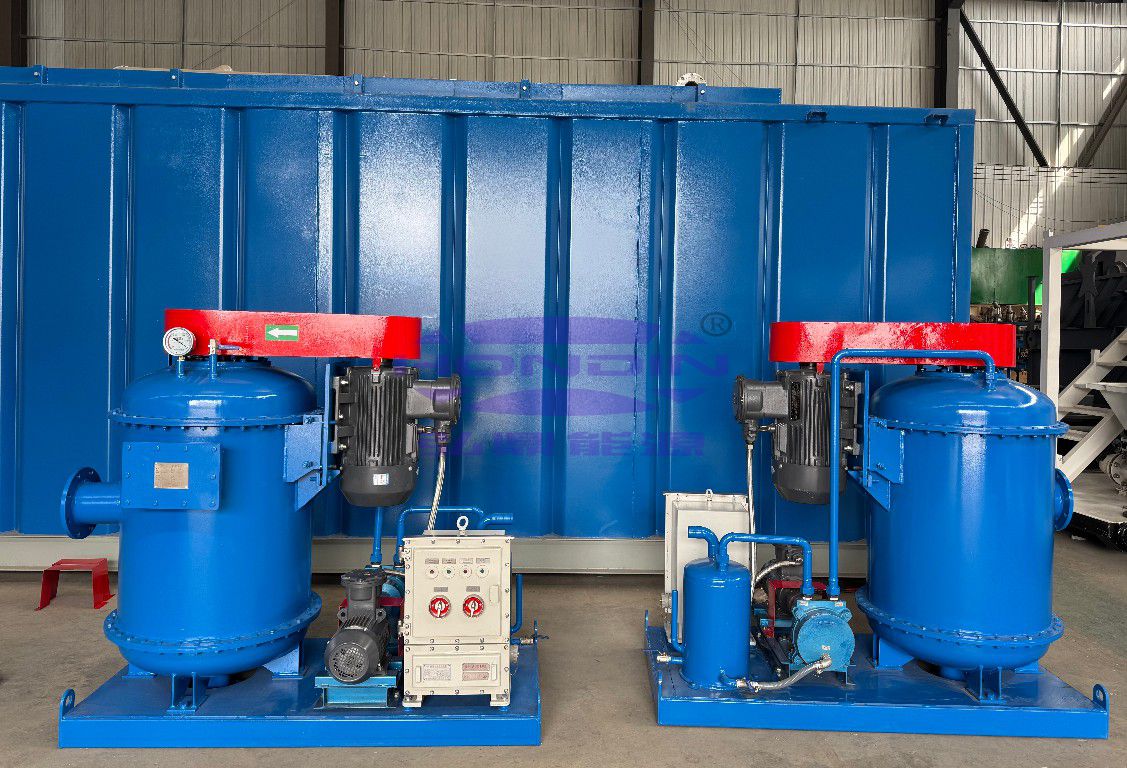
A vacuum degasser is a solids control unit designed to remove entrained gas from drilling fluid. It does not replace well-control equipment and cannot resolve every cause of gas influx. Its practical role is to degas returning drilling fluid, support more stable mud conditions, and reduce gas-related interference with later circulation and separation steps. The unit should be considered together with the shale shaker, mud tanks, centrifugal pumps, desander, desilter, and decanter centrifuge.
Basic Operating Principle
A vacuum degasser generally creates negative pressure in a treatment chamber so that entrained gas bubbles can separate from the drilling fluid and be withdrawn. The treated fluid returns to the circulation system, while separated gas is routed through piping and safeguards appropriate for the location. Equipment designs vary, but the engineering priorities are similar: stable feed, suitable gas-liquid contact, reliable vacuum generation, controlled gas handling, and continuous integration with mud circulation.
The physical location of a degasser should not be copied from a generic drawing without review. The final arrangement depends on the return-flow route, severity of gas cutting, mud system, tank layout, downstream equipment, and required safety distances. A common design objective is to treat gas-cut mud before it reaches downstream units that are more sensitive to flow or density changes, while avoiding layouts that create liquid instability, gas recirculation, or difficult maintenance access.
Selection Considerations
Understand the mud system and gas condition
Water-based, oil-based, and synthetic-based drilling fluids can differ in viscosity, foaming tendency, and gas-release behavior. Before selecting equipment, review mud density, viscosity, solids content, expected circulation rate, frequency of gas cutting, and any special risks associated with hydrocarbon vapor or hydrogen sulfide. For complex intervals, the degassing plan should be reviewed with mud engineering and site safety personnel.

Match the complete circulation system
The degasser must work with mud-tank level, feed arrangement, centrifugal or dedicated pumps, inlet and outlet piping, and control logic. A larger nominal capacity is not automatically a better solution. Unstable feed, insufficient tank volume, or mismatched piping resistance can prevent any unit from operating consistently. Suppliers should be asked to review the circulation diagram, mud parameters, and available space before recommending an arrangement.
Plan safety and maintenance from the start.
Gas routing, ventilation, gas detection, hazardous-area classification, and interlocks should be confirmed against local requirements, the wellsite risk assessment, and project specifications. General marketing language is not a substitute for engineering review. During operation, monitor vacuum condition, liquid level, vibration, seals, discharge piping, and alarms. Maintenance should include the vacuum pump, valves, seals, liquid-distribution components, and checks for blockage or leakage in connected lines.

Practical Value at the Rig Site.
Stable degassing helps limit the effect of gas on mud-property assessment and circulation equipment, allowing downstream solids control units to receive a more manageable feed. For a drilling contractor or equipment buyer, the value lies not in an isolated equipment figure but in the ability to integrate the unit with existing tanks, pumps, controls, and safety practices. With verified operating conditions, sensible layout, operating records, and preventive maintenance, a vacuum degasser can be a dependable supporting unit in a drilling fluid solids control system.








Hot News
-

Vertical Cuttings Dryer for Drilling Waste Management
-
Desander vs Desilter Selection for Solids Control
-
Surface Blending and Pumping Systems for Well Stimulation
-
Produced Water Pretreatment for Reinjection and Reuse
-
Vacuum Degasser Role in Drilling Fluid Solids Control
-
Decanter Centrifuge for Oily Sludge Dewatering
-
Solids Separation in Frac Flowback Fluid Pretreatment
-
Shale Shaker Screen Selection and Maintenance Guide
-
Three-Phase Separation in Oily Sludge Treatment Systems
-
Fracturing Flowback Fluid Treatment for Oilfield Water Reuse
-
The Role of a Decanter Centrifuge in a Solids Control System
-
Fracturing flowback fluid treatment equipment shipment: What customers really need is problem-solving capability.




Add: No.462 Jinggao South Road, Gaoling District, Xi'an, Shaanxi Province, China
Mob/WhatsApp: +86 186 2931 2932/ +86 187 2900 8271
E-mail: sales@hondinchina.com

Follow us:

点击右上角
分享给朋友吧
点击右上角
分享给朋友吧
Copyright © Xi'an Hondin Energy Technology Co., Ltd. All rights reserved
Copyright © Xi'an Hondin Energy Technology Co., Ltd. All rights reserved