

Products


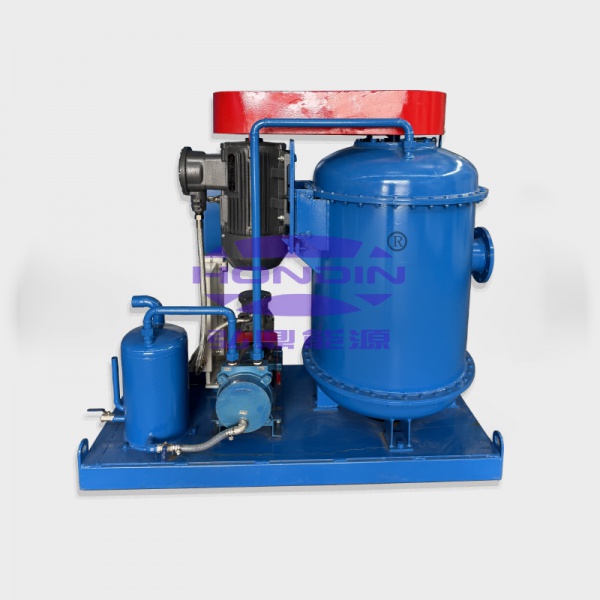
Centrifugal Degasser
Learn about the innovative HONDIN centrifugal degasser (normal pressure degasser) that features a novel structure, integrating the pump and separation tank of traditional degassers and incorporating an exhaust device to improve degassing efficiency by collecting exhaust gas. Discover how during drilling, when mud comes into contact with high-pressure ga
I. Parameters:
| Model | HDCCQ300 | |
| Capacity | 300m³/h | |
| Power | Motor power | 22kw |
| Fan power | 1.5kw | |
| Ratio | 3.38:1 | |
| Outlet size | DN200 | |
| Intlet size | DN200 | |
| Dimension | 1184×1100×3072mm | |
| Weight | 1600kg | |
II. Product Introduction
When drilling mud is exposed to high-pressure gas in the well, some of the gas dissolves in the liquid mud. As the mud returns to the surface, the reduced pressure causes some gas to escape and form bubbles. Some of these bubbles are eliminated as the gas-infiltrated mud passes through a vibrating screen, but smaller bubbles enter the mud tank. Gas-infiltrated mud can cause air resistance in centrifugal pumps. The fluid pressure near the impeller center at the pump inlet is very low, causing bubbles in the gas-infiltrated mud to explode and form gas that accumulates there. As the gas accumulates, it eventually blocks the centrifugal pump inlet, causing it to lose suction. Furthermore, if gas-infiltrated mud is pumped into the well, it leads to uncontrollable mud density. If this occurs when the mud counteracts the bottom hole pressure, it can cause a blowout.

Engineers at Xi'an HONDIN Energy Technology Co., Ltd. (hereinafter referred to as HONDIN) have drawn on the advantages of related foreign products and combined them with their own unique characteristics to develop the domestically produced HDCCQ300 centrifugal degasser (atmospheric pressure degasser). Compared with traditional vacuum degassers, HONDIN's HDCCQ300 centrifugal degasser (atmospheric pressure degasser) features a smaller footprint and higher degassing efficiency, making it well-suited to the limited space on drilling platforms.
The HDCCQ300 centrifugal degasser (atmospheric pressure degasser) adopts a new structure, combining the pump and separator tank of previous degassers into one, adding an exhaust device to collect the discharged gas, and enhancing the degassing effect. When the degasser spindle rotates, the impeller first drives the filtered drilling fluid, after being treated by the filter screen, to rise from the bottom of the degasser, forming a thin layer on the inner wall of the cylinder. At this point, the drilling fluid experiences centrifugal force with an acceleration 42 times the force of gravity, causing the gas within the fluid to rapidly move towards the center and break up, being collected and discharged by the blower above.
The degasser consists of a centrifugal pump and a centrifuge. The degasser inlet pipe extends below the mud surface and is filled with mud. When the 22KW main motor starts, the impeller at the bottom of the degasser (inside the inlet pipe) begins to rotate the mud, lifting it to the top of the degasser. The mud in the inlet pipe rises in a rotating manner because the bottom inlet of the degasser is smaller than the top. After reaching the top of the inlet, the mud overflows and enters the discharge chamber. Inside the discharge chamber, the mud velocity decreases, but the pressure increases. After being processed in the discharge chamber, the mud enters the outlet pipe. As the mud rotates and rises within the inlet pipe, the centrifugal force from the rotation extends it into a layer of approximately 15 mm. This centrifuge compresses air bubbles within the mud to the center of rotation. When these bubbles reach the surface of the mud, they detach from the mud, forming free gas, which is discharged through the degassing pipe. Simultaneously, the mud is discharged through the outlet pipe. A blower system guides the gas exiting the discharge chamber and discharges it through pipelines. A vacuum piping system connects the blower and the discharge chamber and prevents mud from entering the blower.

III. Features of the HDCCQ300 Centrifugal Deaerator (Ambient Pressure Deaerator):
1. High throughput up to 300 m³/h.
2. The impeller's agitation reduces mud viscosity, facilitating gas removal; the buoyancy of air bubbles is 42 times greater than in a static state, resulting in high degassing efficiency.
3. Except for mechanical losses, all remaining energy is used to directly drive the mud, resulting in high operating efficiency.
4. Ideal for confined spaces such as drilling platforms and modular drilling rigs; compact structure and small footprint.
5. Convenient maintenance.


 Copy product links
 Long by picture save/share
INQUIRY


Add Successfully
INQUIRY
Add Successfully
Hot product




Add: No.462 Jinggao South Road, Gaoling District, Xi'an, Shaanxi Province, China
Mob/WhatsApp: +86 186 2931 2932/ +86 187 2900 8271
E-mail: sales@hondinchina.com

Follow us:

点击右上角
分享给朋友吧
点击右上角
分享给朋友吧
Copyright © Xi'an Hondin Energy Technology Co., Ltd. All rights reserved
Copyright © Xi'an Hondin Energy Technology Co., Ltd. All rights reserved